
Beyond ABCs and 123s: The Vital Role of Emotional Intelligence in Pre-Primary Education
In the competitive landscape of modern parenting, specifically in high-growth academic hubs like ours, there is an understandable obsession with milestones. We often find ourselves asking quantifiable questions: “Can he count to 100?” “Does she know her phonics?” “Is he writing in cursive yet?” These are the metrics of IQ-cognitive intelligence-and while they are certainly important, they are not the only, or even the most significant, predictors of a child’s future success. There is a quieter, less visible engine driving your child’s development, one that determines not just how smart they are, but how happy, resilient, and socially capable they will become. This engine is Emotional Intelligence (EQ).
In the bustling classrooms of a pre-primary section, amidst the finger painting and the nursery rhymes, a profound neurological construction project is underway. The brain of a child under the age of six is more plastic and receptive than it will ever be again. While this is a prime time for learning languages and logic, it is also the critical window for wiring the brain for emotional regulation and empathy. At our school, we believe that the role of pre-primary education is not merely to prepare children for Grade 1 academics, but to prepare them for life. This begins by placing Emotional Intelligence at the very center of our curriculum.
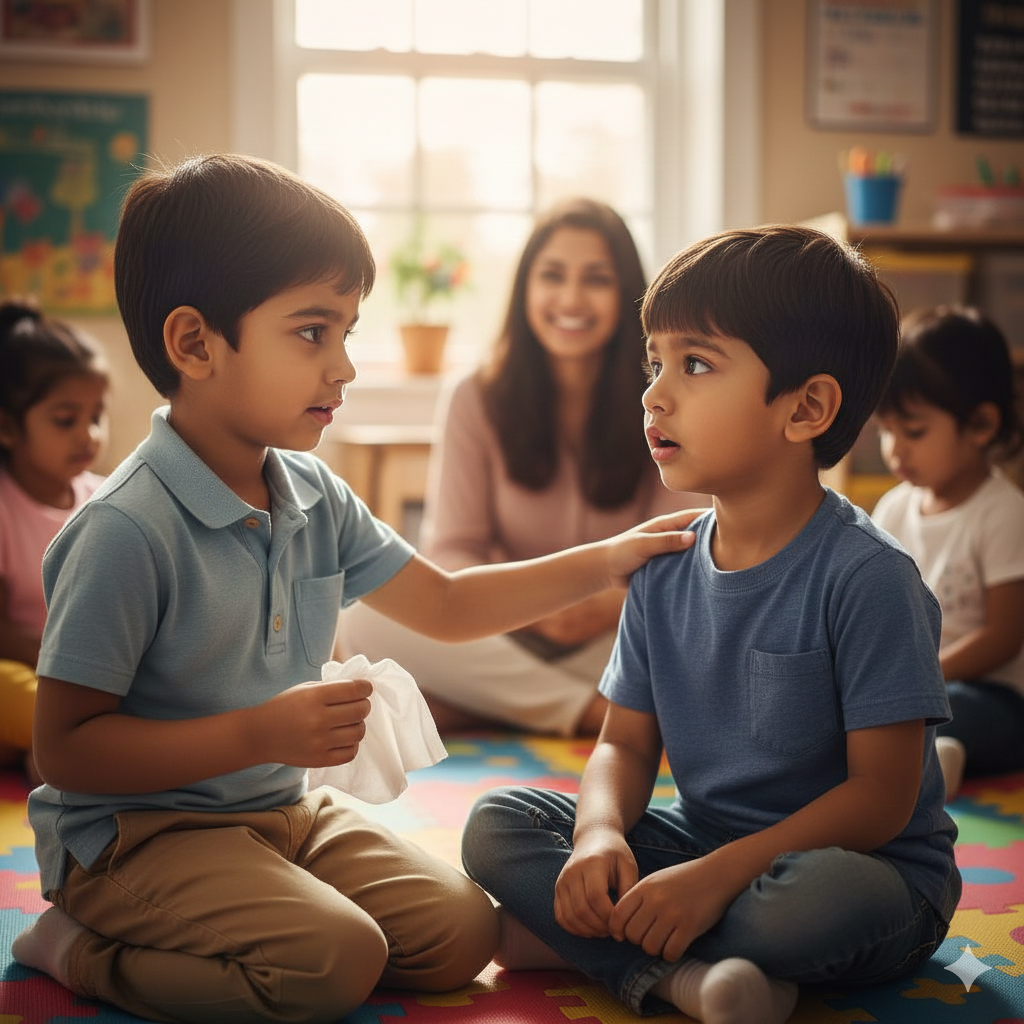
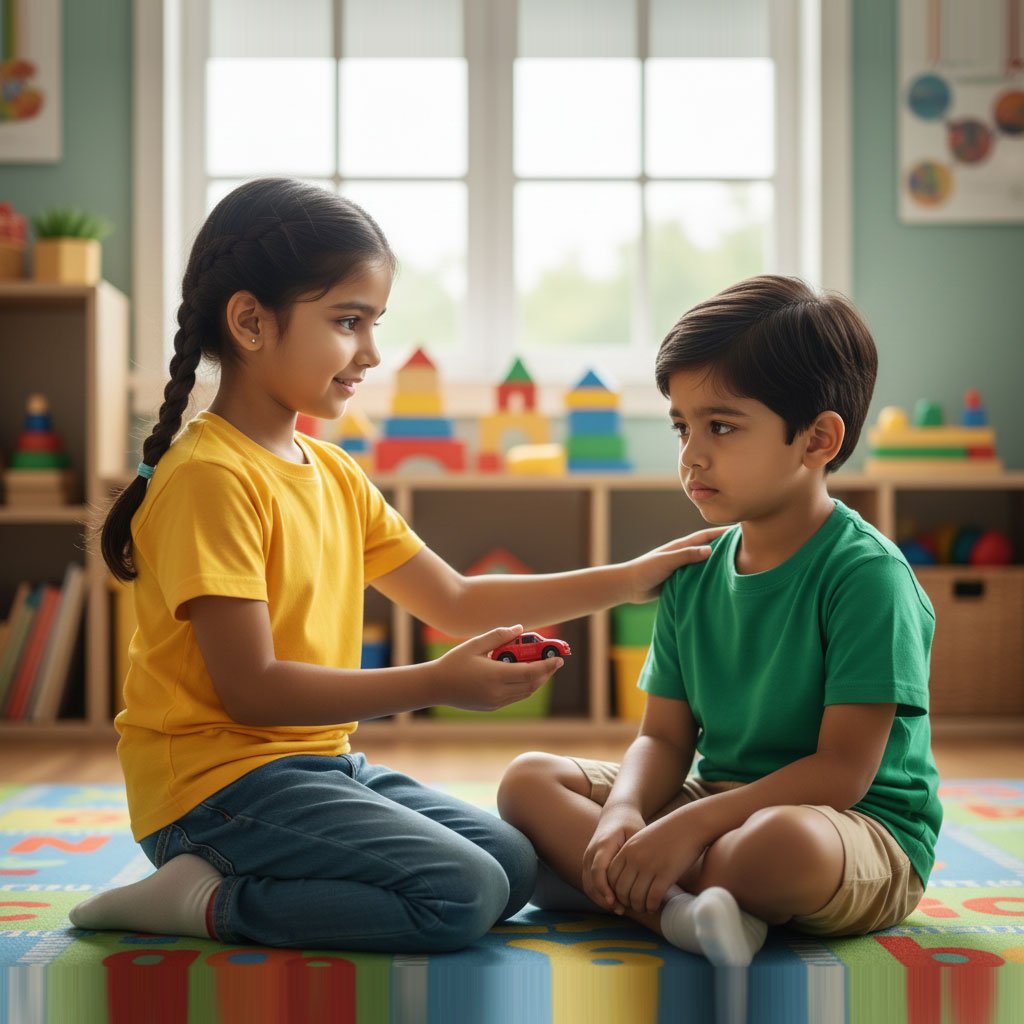
"Kindness is a language the deaf can hear and the blind can see. Fostering a culture of empathy from the very start."
What Does Emotional Intelligence (EQ) Look Like in a Four-Year-Old?
To the untrained eye, Emotional Intelligence might sound like a complex concept reserved for corporate leadership seminars or adult therapy sessions. However, in the context of a preschooler, EQ is beautifully simple yet incredibly challenging. It is the ability to identify, understand, and manage one’s own emotions, and to recognize the emotions of others. For a three-year-old, this doesn’t mean sitting in quiet meditation. It looks like a child pausing before hitting a friend who took their toy. It looks like a student noticing a classmate crying and offering a pat on the back. It is the transition from the primal scream of a tantrum to using words like, “I am angry because I wanted the blue truck.”
In the pre-primary years, children are navigating a storm of big feelings in little bodies. They do not yet have the vocabulary to express frustration, jealousy, or overwhelming joy. Without guidance, these feelings manifest as biting, pushing, or shutting down. The role of the educator in this phase is to act as an emotional translator. When a teacher gets down to eye level with a frustrated child and says, “I see that you are mad because playtime is over,” they are teaching the child the first pillar of EQ: Self-Awareness. By naming the emotion, we tame the emotion. This fundamental skill is the bedrock upon which all future learning is built. A child who cannot regulate their frustration cannot sit through a math lesson. A child who cannot navigate social conflict cannot work on a science project in a team.
The Science of Self-Regulation and the "Tantrum"
One of the most misunderstood aspects of early childhood is the “tantrum.” Often viewed by parents as behavioral defiance or a failure of discipline, a tantrum is actually a biological event-a system overload. In early childhood education, we view these moments not as problems to be silenced, but as opportunities for coaching. This is where the skill of Self-Regulation comes into play. Self-regulation is the ability to monitor and manage your energy states, emotions, thoughts, and behaviors in ways that are acceptable and produce positive results such as well-being, loving relationships, and learning.
In our classrooms, we actively teach self-regulation strategies. We might use “calm-down corners” filled with sensory toys, or teach deep breathing techniques like “smell the flower, blow out the candle.” When a child learns to self-regulate, they are developing the neural pathways in the prefrontal cortex-the part of the brain responsible for executive function. Research has shown that children with higher self-regulation skills in preschool are more likely to achieve higher academic grades in high school and even have better health outcomes as adults. By prioritizing this in pre-primary, we are essentially giving children the keys to their own nervous systems.
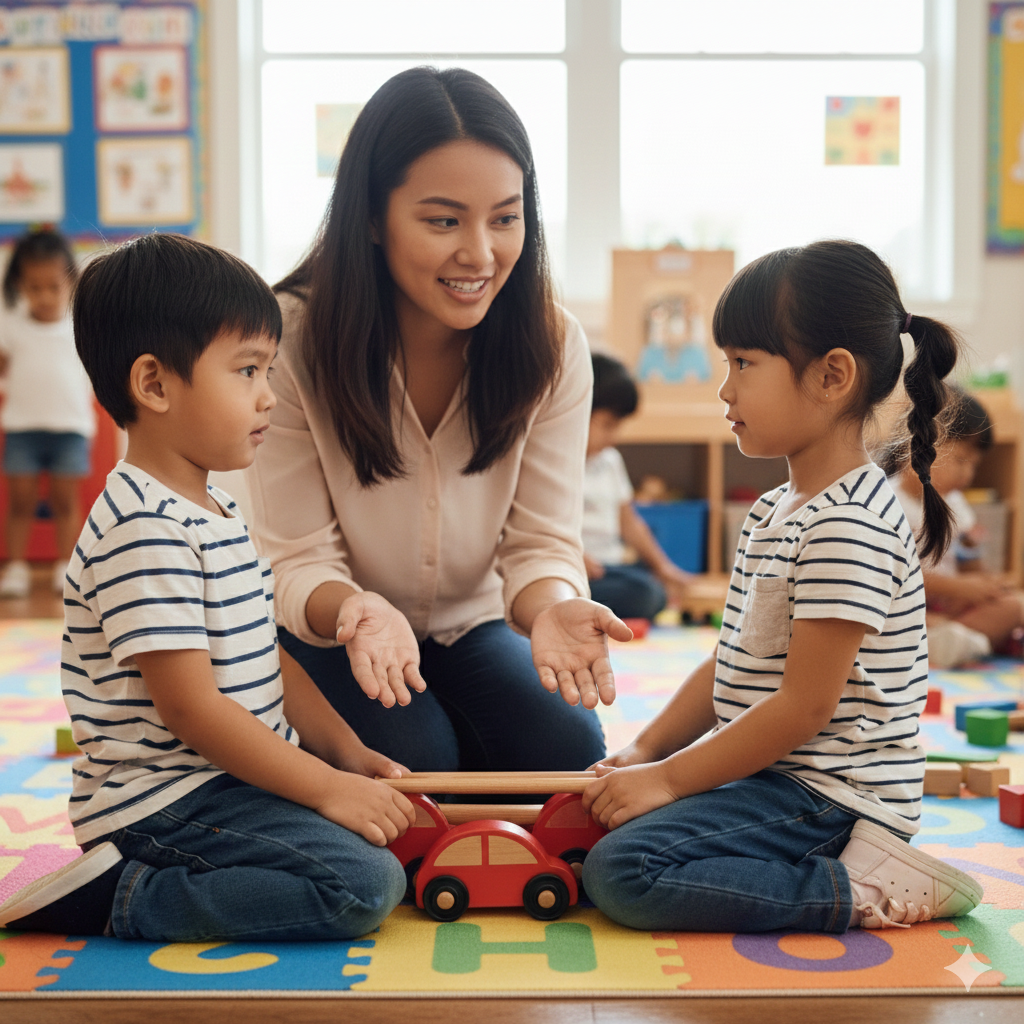
Turning conflicts into curriculum. Every dispute is an opportunity to learn empathy and negotiation.
Empathy: The Social Glue of the Classroom
If self-regulation is the internal work of EQ, empathy is the external application. The pre-primary classroom is often a child’s first real foray into a community of peers. Unlike home, where they may be the center of attention, school requires them to share space, resources, and attention with twenty other children. This is the perfect laboratory for developing empathy.
Empathy in early years isn’t just about being “nice.” It is a complex cognitive skill that requires a child to step out of their own egocentric worldview and imagine the perspective of another. It is the realization that “If I knock over his tower, he will feel sad.” Teachers facilitate this by narrating social interactions. Instead of simply forcing a child to say “sorry” (which often becomes a meaningless script), a teacher might ask, “Look at his face. How do you think he is feeling right now?” This prompts the child to read non-verbal cues-facial expressions, body language, and tone of voice. In an increasingly digital world where face-to-face interaction is competing with screens, these lessons in reading human emotion are more vital than ever.
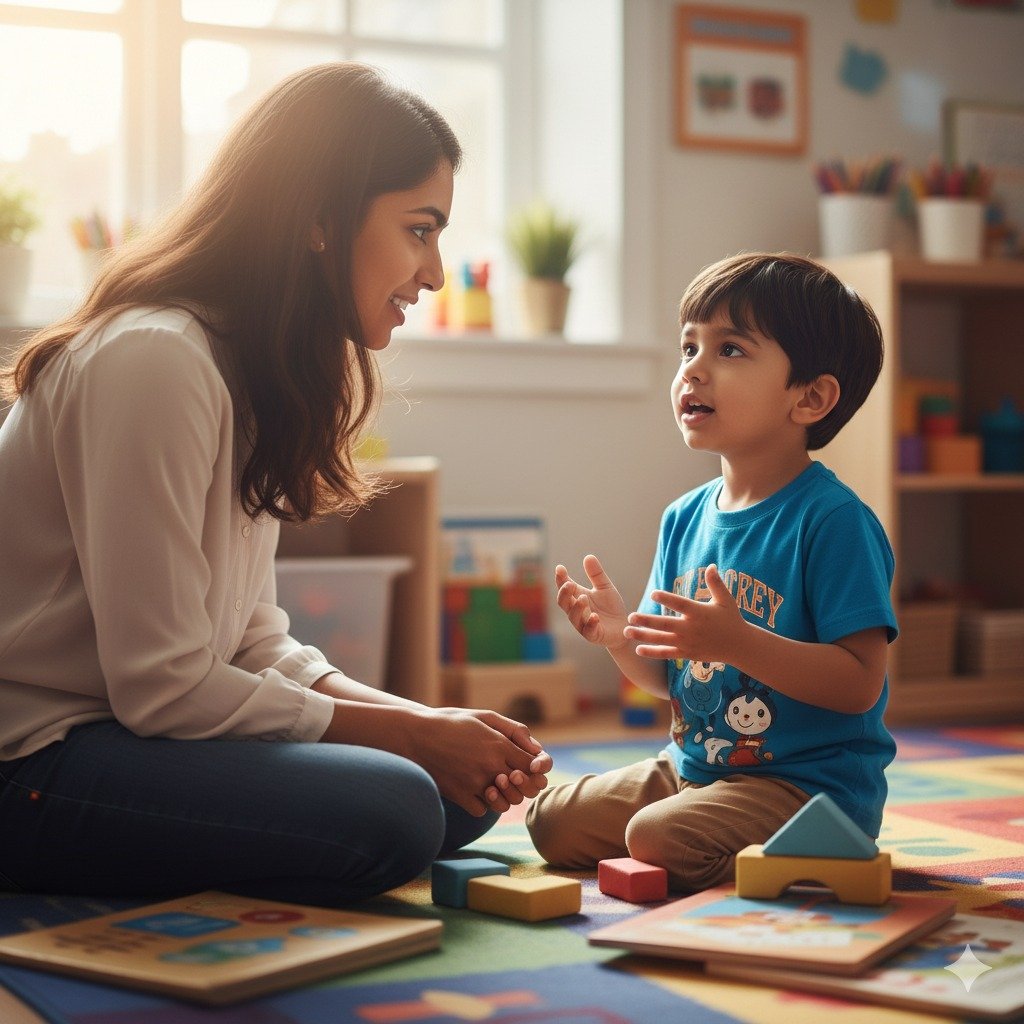
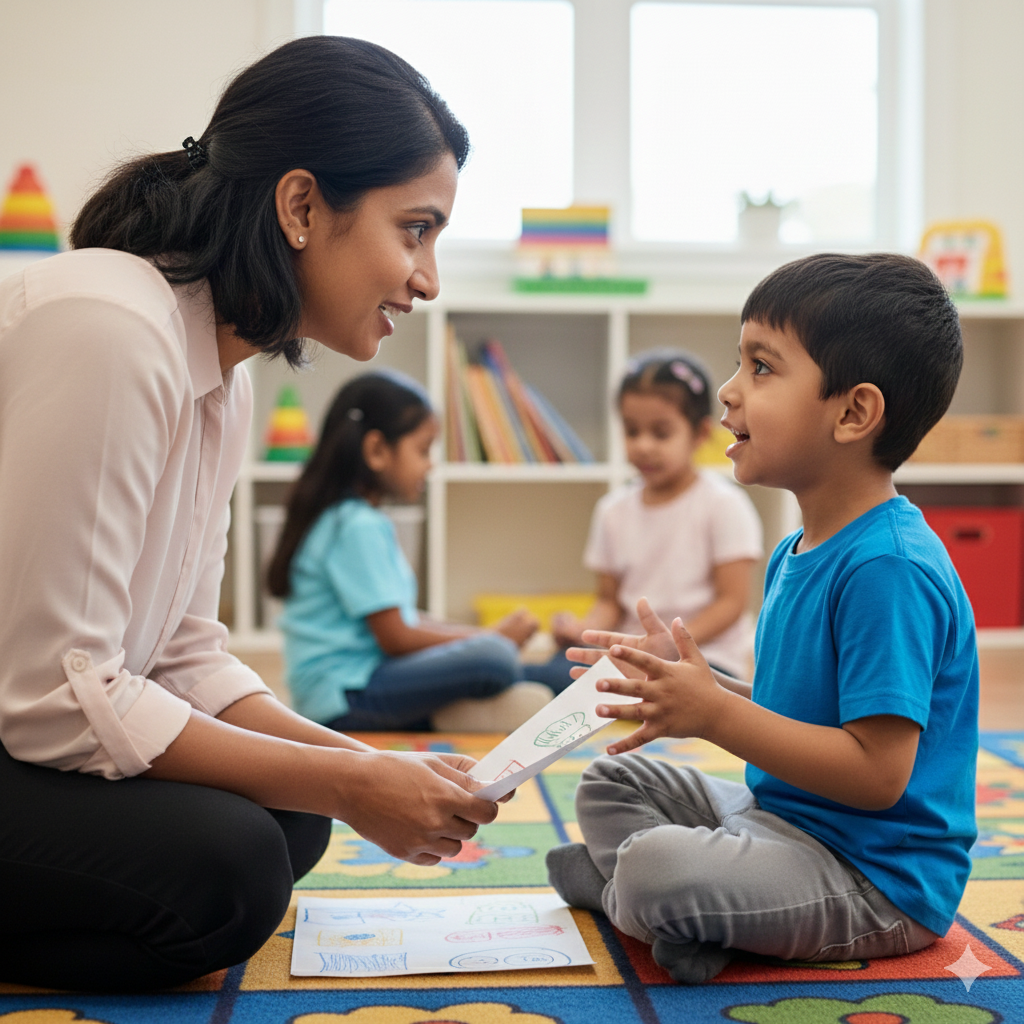
True understanding begins at eye level. Our teachers guide students through big feelings with patience and respect.
The Link Between EQ and Academic Success
Parents often worry that focusing too much on feelings will detract from “real” learning. However, the data suggests the exact opposite. Emotional Intelligence is the gatekeeper of learning. When a child feels safe, understood, and emotionally regulated, their brain is in a state of “relaxed alertness”-the optimal state for absorbing new information. Conversely, when a child is anxious, overwhelmed, or socially isolated, their brain enters a “fight or flight” mode, effectively shutting down the centers responsible for memory and logic.
Therefore, investing time in EQ is actually an investment in academic excellence. A child with high EQ can handle the disappointment of a wrong answer without giving up. They can ask for help when they are confused. They can collaborate with peers to solve complex problems. These are the “soft skills” that the World Economic Forum lists as the top requirements for the future workforce. We are preparing children for jobs that haven’t been invented yet, and in an age of Artificial Intelligence, the uniquely human capacity for emotional connection and complex social navigation will be the most valuable skill set they possess.
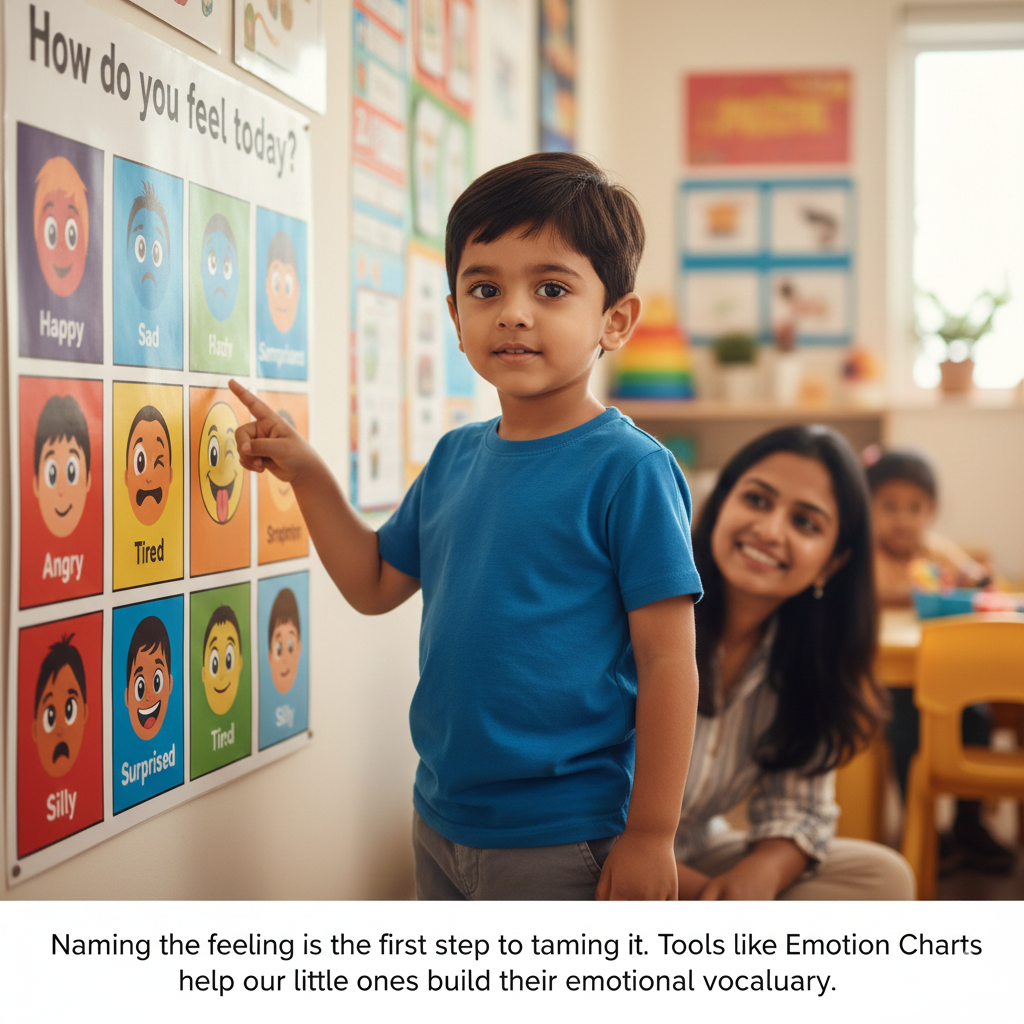
Partnering with Parents: Bringing EQ Home
The work we do in the classroom is most effective when it is mirrored at home. We encourage parents to become “Emotion Coaches” rather than just disciplinarians. This means validating your child’s feelings even when you limit their behavior. For example, saying, “It is okay to be angry that we have to leave the park, but it is not okay to hit,” validates the emotion while setting a boundary.
We also encourage parents to model their own emotional process. It is healthy for children to see their parents handle stress or disappointment constructively. If you burn dinner, instead of shouting, narrate your process: “I am feeling frustrated that I burned the toast, but I am going to take a deep breath and make a new piece.” Children are excellent mimics; they will learn more from watching how you handle a crisis than from any lecture you give them.
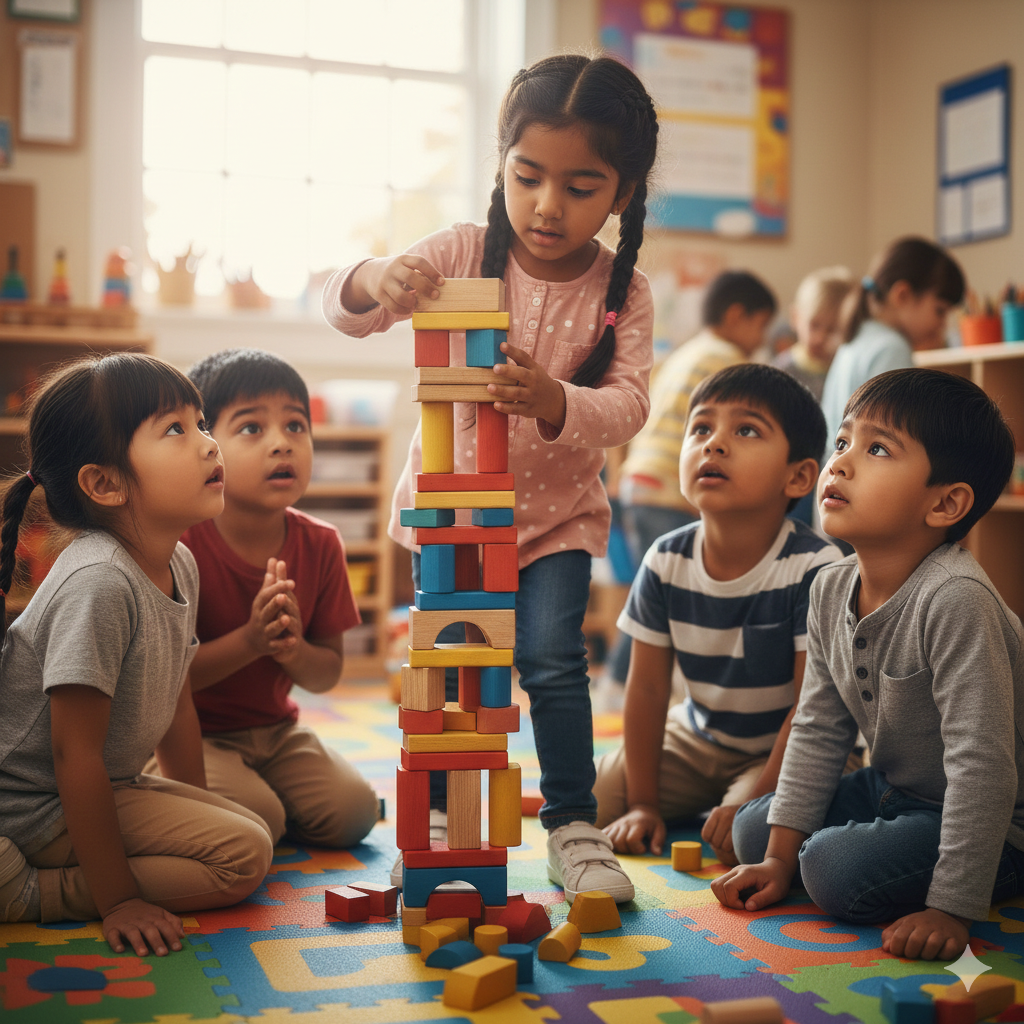
Building towers and building trust. Collaborative play teaches patience, turn-taking, and shared joy.
Conclusion: Raising Whole Human Beings
At the end of the day, our goal in pre-primary education is not just to produce students who are “school-ready,” but to nurture human beings who are “life-ready.” We want to send children into the world who are not only intelligent but also kind. We want them to be resilient enough to face failure, confident enough to assert their needs, and compassionate enough to lift others up.
By weaving Emotional Intelligence into the fabric of our daily routines-through stories, play, conflict resolution, and modeled behavior-we are laying a foundation that will support them for decades to come. The alphabets and numbers will come in time, and they will be mastered. But the ability to understand oneself and connect with others? That is the lesson of a lifetime, and it starts right here, in the joyful chaos of the pre-primary classroom.