
Why Life Skills Belong in a Strong School Curriculum
A strong school curriculum should prepare children for more than examinations. Academic knowledge gives students an important foundation, but children also need to learn how to communicate, make decisions, solve problems, manage emotions, work with others, and take responsibility for everyday situations.
For parents searching for the Best preschool near Miyapur, this broader approach to education is increasingly important. The early years are an opportunity to develop habits and behaviours that can influence how children approach learning, relationships, challenges, and independence as they grow.
Life skills do not need to be taught as isolated textbook chapters. They can become part of everyday school experiences through classroom activities, play, projects, sports, creative work, discussions, practical tasks, and meaningful interactions.
What Are Life Skills in School Education?
Life skills are practical abilities that help children handle everyday situations effectively and responsibly.
They include communication, decision-making, problem-solving, teamwork, self-awareness, emotional regulation, adaptability, empathy, organisation, and responsible behaviour.
For young children, these skills can begin with simple experiences. Packing away materials, taking turns, explaining an idea, asking for help, resolving a disagreement, or completing a small classroom responsibility can all become meaningful learning opportunities.
A school that intentionally develops these abilities helps children understand that education is not limited to marks and memorisation.
Why Life Skills Should Start Early
The preschool and primary years are important stages for developing independence.
Young children are naturally curious and eager to explore their surroundings. Instead of doing everything for them, educators can provide age-appropriate opportunities to make choices, attempt tasks, communicate their needs, and learn from mistakes.
This approach can gradually build confidence.
At Fountainhead Global School, the school’s stated educational approach includes life skills and character building as part of its broader future-ready education philosophy. Its campus also includes dedicated spaces such as a Life Skill Workshop, Social Emotional Learning Centre, Brain Gym, and Living Classrooms.
1. Communication Builds Confidence
Communication is one of the most valuable life skills a child can develop.
Children need opportunities to express ideas, describe experiences, ask questions, listen carefully, and communicate their feelings. These abilities support both academic learning and social development.
Teachers can encourage communication through storytelling, classroom conversations, presentations, role play, group discussions, and collaborative projects.
For preschool children, even a simple activity such as describing a drawing or explaining how they built something can strengthen vocabulary and confidence.
Parents evaluating a preschool curriculum can therefore look for opportunities where children are encouraged to speak, listen, interact, and express themselves rather than simply complete worksheets.
2. Problem-Solving Turns Challenges Into Learning
Children encounter small problems every day.
A toy may not work as expected. A construction model may fall apart. Two students may want the same resource. A group project may not go according to plan.
Instead of immediately providing the answer, teachers can encourage children to think about possible solutions.
This develops problem-solving skills and helps students understand that mistakes are not necessarily failures. They can be opportunities to try another approach.
FHGS identifies practical higher-order thinking and problem-solving as part of its educational approach.
3. Emotional Intelligence Matters
Academic achievement is only one part of a child’s development.
Children also need to recognise emotions, understand how their actions affect others, manage frustration, and respond appropriately to different situations.
These abilities are closely connected with emotional intelligence for children.
A teacher might help students identify how they feel after losing a game, guide them through a disagreement, or encourage them to consider how another child might feel.
Over time, these experiences can help children become more aware of themselves and more considerate of others.
4. Teamwork Teaches Children to Cooperate
Many real-world situations require people to work with others.
Classroom projects, sports, music, drama, art, and group activities can create natural opportunities for children to practise cooperation.
Students learn that teamwork involves listening to different opinions, sharing responsibilities, respecting other people’s contributions, and working toward a common objective.
A strong holistic education model therefore does not treat extracurricular activities as merely optional entertainment. Activities outside traditional academic lessons can become valuable environments for developing social and interpersonal skills.
FHGS describes its programs as combining theoretical and practical learning experiences and lists sports, arts, workshops, cultural activities, and other experiences among its broader educational environment.
5. Independence Helps Children Become Responsible
Independence develops gradually.
A preschool child may begin by putting away toys. An older child may organise school materials, complete a classroom responsibility, prepare for a presentation, or manage part of a project.
These small responsibilities can build a sense of ownership.
The objective is not to expect young children to manage everything independently. Instead, teachers can provide appropriate support and gradually allow students to take greater responsibility as their abilities develop.
This is an important part of early childhood development, particularly during the transition from home-based routines to a structured school environment.
6. Decision-Making Is a Skill Worth Practising
Children make decisions every day.
Which material should they use? How should they complete a project? What should their group do first? How can they solve a disagreement?
Giving children controlled opportunities to make decisions can help them understand consequences and develop judgement.
Teachers can offer choices that are appropriate for the child’s age while providing guidance when needed.
This creates a learning environment where students are not simply following instructions but gradually learning to think about their choices.
7. Practical Activities Make Life Skills Natural
Life skills become more meaningful when children practise them rather than only hear about them.
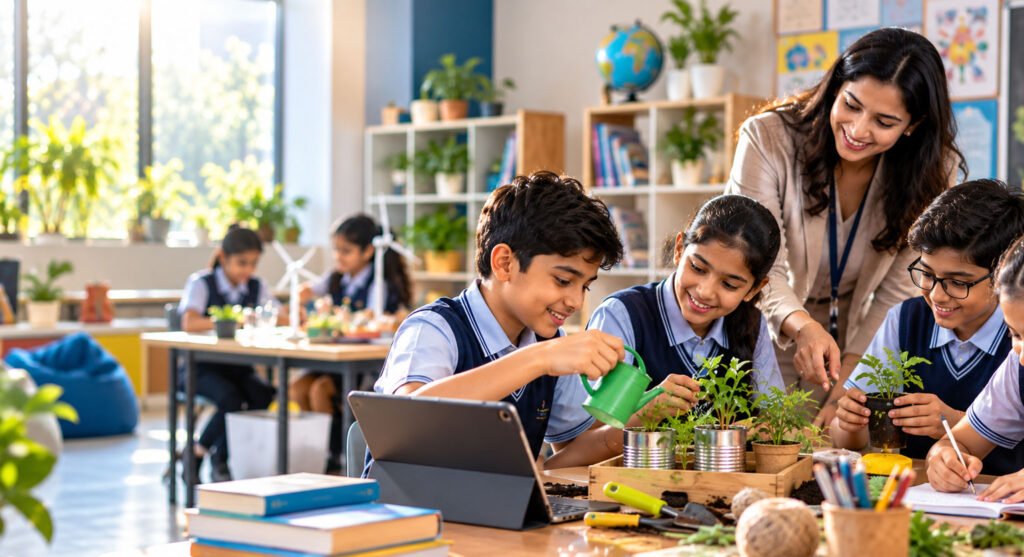
For example, a school garden can introduce responsibility and environmental awareness. Cooking or food-related activities can introduce planning, measurement, hygiene, teamwork, and healthy choices.
Arts and crafts can encourage creativity and patience. Sports can develop cooperation, resilience, discipline, and respect.
FHGS’s listed learning spaces include a vegetable garden, animal house, outdoor gym, arts and crafts facilities, workshops, and STEAM Maker Space, providing different environments for practical experiences.
8. Life Skills Support Academic Learning
Life skills and academics should not be treated as competing priorities.
A student who can communicate clearly may participate more effectively in classroom discussions. A child who has developed organisation skills may manage schoolwork more effectively. A student who knows how to collaborate can contribute productively to group projects.
Likewise, problem-solving, creativity, critical thinking, and persistence can strengthen academic learning.
This is why experiential learning can be valuable. Students can encounter concepts through activities, practical tasks, projects, and real situations rather than relying exclusively on passive instruction.
FHGS states that its primary curriculum encourages curiosity and different approaches to teaching, while its middle-school approach encourages students to connect school learning with the world beyond the classroom.
9. Character Building Belongs in Everyday Learning
Character development is not something that needs to happen in a separate period.
Respect, honesty, responsibility, empathy, perseverance, and kindness can be reinforced throughout the school day.
Teachers can model these behaviours and create classroom situations where students practise them.
This makes character building in schools a continuous process rather than a collection of slogans or occasional activities.
Children learn character through what they experience repeatedly: how adults respond to mistakes, how classmates treat one another, how responsibilities are shared, and how challenges are handled.
10. The Learning Environment Also Matters
The physical environment can influence how children interact with learning.
Flexible spaces, play areas, creative rooms, outdoor environments, laboratories, activity areas, and collaborative classrooms can give students different ways to explore ideas.
FHGS describes its campus as having dynamic learning spaces that include multimedia learning areas, playgrounds, AR/VR/AI labs, arts and crafts, social-emotional learning, dance and music, educational trips, language learning, indoor and interactive play, STEAM Maker Space, and life-skill facilities.
For parents considering a child-friendly school environment, it can therefore be useful to look at how spaces are actually used rather than focusing only on the number of facilities available.
What Parents Should Look For in a School
When searching for the Best preschool near Miyapur, parents can look beyond classroom size, worksheets, and academic claims.
Consider asking:
- Are children encouraged to communicate and ask questions?
- Do students get opportunities to make age-appropriate choices?
- Are practical activities part of regular learning?
- How does the school support emotional and social development?
- Are sports, arts, projects, and creative activities integrated into the school experience?
- Do children have opportunities to develop independence?
- How does the school encourage teamwork and problem-solving?
- Are teachers attentive to individual children’s needs?
A strong student-centred learning approach should allow children to participate actively rather than simply receive information.
Life Skills Prepare Children for the Future
The future will require children to adapt to situations that cannot always be predicted.
Technology will change. Careers will evolve. Students will encounter new problems, new forms of communication, and increasingly complex social environments.
Academic knowledge will remain important, but children will also need curiosity, adaptability, collaboration, communication, resilience, and the ability to keep learning.
That makes future-ready education broader than teaching technology. It means developing the habits and capabilities that help children approach change with confidence.
Conclusion
Life skills belong in a strong school curriculum because education should prepare children for life as well as examinations.
Communication, emotional intelligence, problem-solving, teamwork, decision-making, independence, responsibility, creativity, and resilience can be developed through everyday classroom experiences, practical activities, sports, projects, creative pursuits, and meaningful interactions.
For parents searching for the Best preschool near Miyapur, the most useful question may not simply be what children will learn, but how they will learn to use that knowledge in real situations.
A school that combines academic learning with practical experiences and life-skill development can give children a broader foundation for their next stage of education—and for the many experiences that come beyond the classroom.