
Top Play School in Kukatpally: Key Features Every Parent Should Look For
If you live in Kukatpally, you already know the vibe. It is a neighborhood that never really sleeps-a bustling, high-energy microcosm of modern Hyderabad. With young IT professionals, nuclear families, and a deeply ingrained culture that values education, it is no surprise that the streets of KPHB, Vivekananda Nagar, and Nizampet are lined with preschools.
For a parent stepping into this arena for the first time, the sheer volume of choices is overwhelming. Leaving your child in a new environment for the first time is naturally anxiety-inducing, and the marketing brochures don’t make it any easier. Every school claims to be the “best,” boasting colorful walls and imported toys.
But as we look at the educational standards required in 2026, finding a top play school is about peeling back the marketing layers and looking at the core mechanics of how a school operates. A true early learning center doesn’t just babysit; it wires your child’s brain for lifelong learning.
If you are touring preschools in Kukatpally this weekend, here is a candid, reality-grounded guide to the essential features you must look for before signing that admission form.
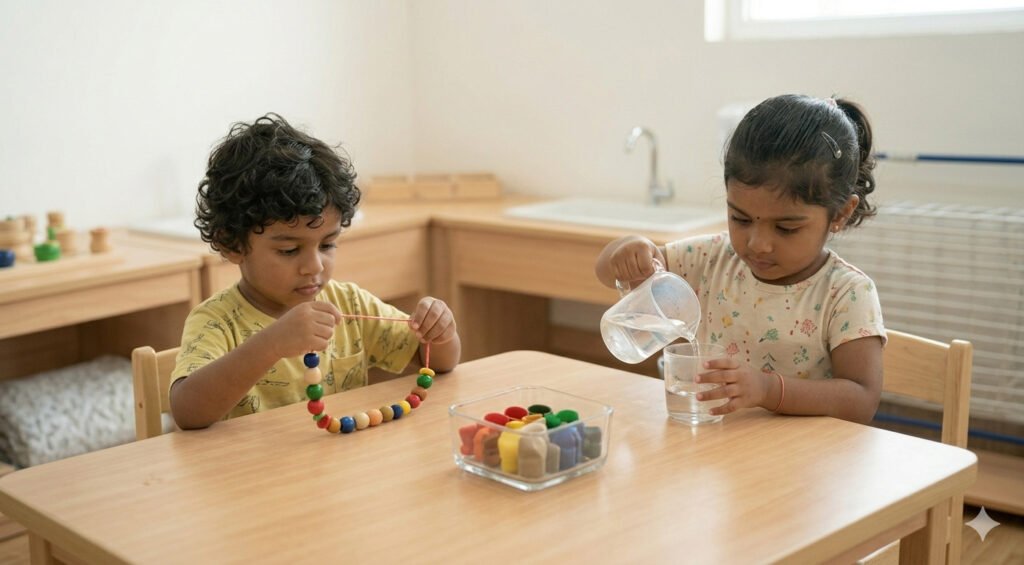
1. A Curriculum That Builds Skills, Not Just Memory
Let’s be honest: reciting the alphabet at age two is a neat party trick, but it is not a true measure of cognitive development. Top play schools have moved far beyond rote memorization. Today, early childhood education is about establishing the foundational wiring for critical thinking, emotional regulation, and social interaction.
When evaluating a play school, ask to see their curriculum framework. You should be looking for a holistic approach that balances structured learning with free play.
- Inquiry-Based Learning: Does the curriculum encourage children to ask “why“? Activities should be designed around exploration-like playing with sand and water to understand volume, or mixing paint to learn about primary colors.
- Motor Skill Development: The curriculum must explicitly target gross motor skills (running, balancing, jumping) and fine motor skills (threading beads, using child-safe scissors, gripping crayons). These are the prerequisites for writing.
A modern play school will often blend methodologies-taking the structured independence of Montessori and the creative expression of Reggio Emilia-to create a well-rounded environment tailored to the developmental milestones of toddlers.
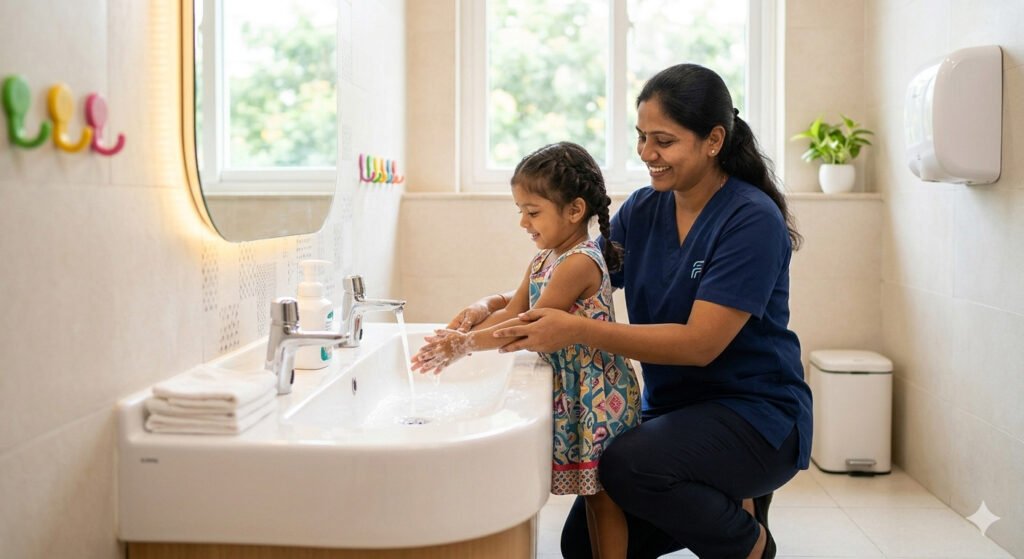
2. Uncompromising Safety and Child-Centric Infrastructure
Kukatpally is densely populated, and traffic on roads connecting JNTU to Hitech City or the internal phases of KPHB can be chaotic. Once you walk through the gates of a play school, the environment must instantly feel like a secure, isolated sanctuary. Safety is not a luxury; it is the baseline.
When you take a campus tour, do your own mental audit:
- Access Control: Is there a dedicated guard? More importantly, what are the handover protocols? A top school will have strict login and logout
- policies for whoever comes to pick up the child.
- Child-Proofing: Look down. Are the edges of the tables rounded? Are electrical outlets covered? Are the toys made of non-toxic materials and sanitized daily?
- Hygiene and Washrooms: This is often the deciding factor. Toddlers are still navigating potty training. Washrooms must be child-sized, brightly lit, dry, and always supervised by female support staff. A school’s true standard of care is reflected in its washrooms, not its reception area.
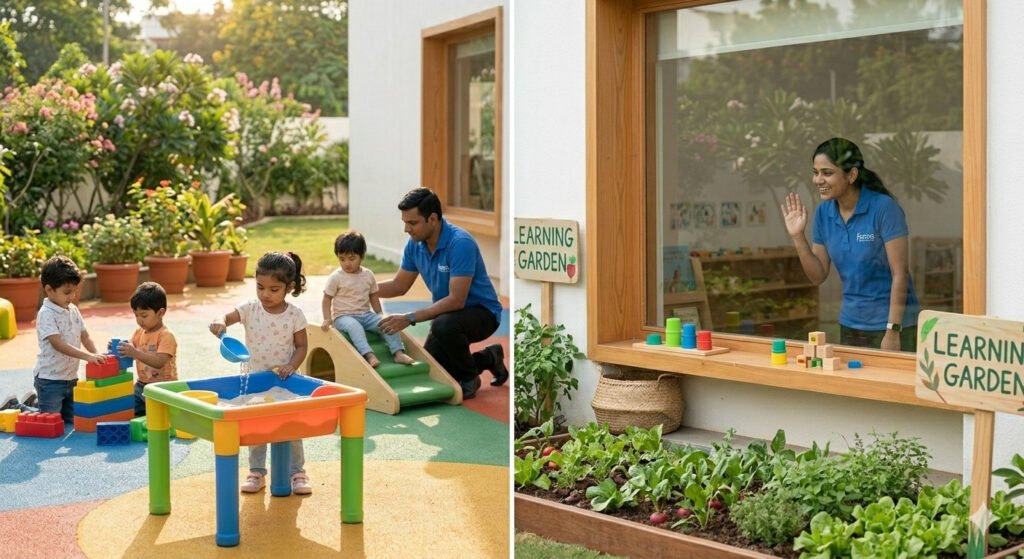
3. The Classroom Layout: Active Learning Zones
A play school classroom should look drastically different from a high school classroom. If you see rows of desks facing a blackboard, turn around. Toddlers learn by moving, touching, and doing.
The best play schools in Kukatpally utilize “Learning Zones.” The classroom should be divided into distinct, purposeful areas:
- A Reading Nook: Filled with age-appropriate picture books and soft seating to foster a love for reading.
- A Creative Station: Stocked with paints, clay, and craft materials for sensory and artistic expression.
- A Block/Building Area: For spatial awareness and collaborative play.
This decentralized layout allows children to exercise choice, promoting independence and keeping them engaged rather than forcing a room full of three-year-olds to focus on a single teacher at the front.
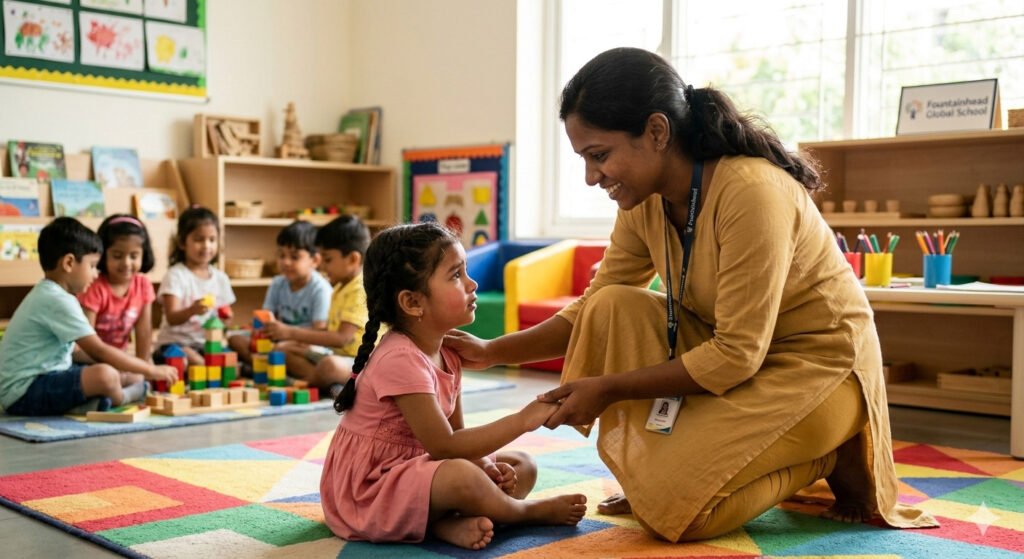
4. Emotionally Intelligent and Qualified Educators
You can have the most beautifully designed campus in Kukatpally, but if the teachers lack empathy and training, the school will fail your child. In the early years, the emotional bond between the educator and the child dictates the learning outcome.
During your visit, observe the teachers in action:
- The Eye-Level Rule: Are the teachers kneeling down to speak to the children face-to-face, or are they talking down to them?
- Handling Big Emotions: Ask the principal directly: “How do your teachers handle a toddler having a meltdown?“ You want an answer that involves redirection, patience, and emotional validation-never scolding, shaming, or “time-outs.”
- Teacher-to-Student Ratio: Toddlers require intense supervision and personalized attention. Look for a ratio of 1:8 or 1:10 at the playgroup and nursery levels. Anything higher, and the teacher becomes a crowd controller rather than an educator.
5. Proximity and the Reality of the Commute
It is tempting to choose a high-profile preschool located 10 kilometers away, but you have to factor in the reality of Kukatpally traffic. Putting a three-year-old on a school bus for 45 minutes every morning and afternoon is a recipe for exhaustion and crankiness.
A tired child cannot learn or play effectively. Choose a school that is either close to your home (within a 3 to 5 km radius, like in Pragathi Nagar, KPHB, or Vivekananda Nagar) or conveniently located on your daily commute to work. If you opt for school transport, verify that the vans have real-time GPS tracking and a female attendant present at all times.
6. Transparent Parent-School Partnership
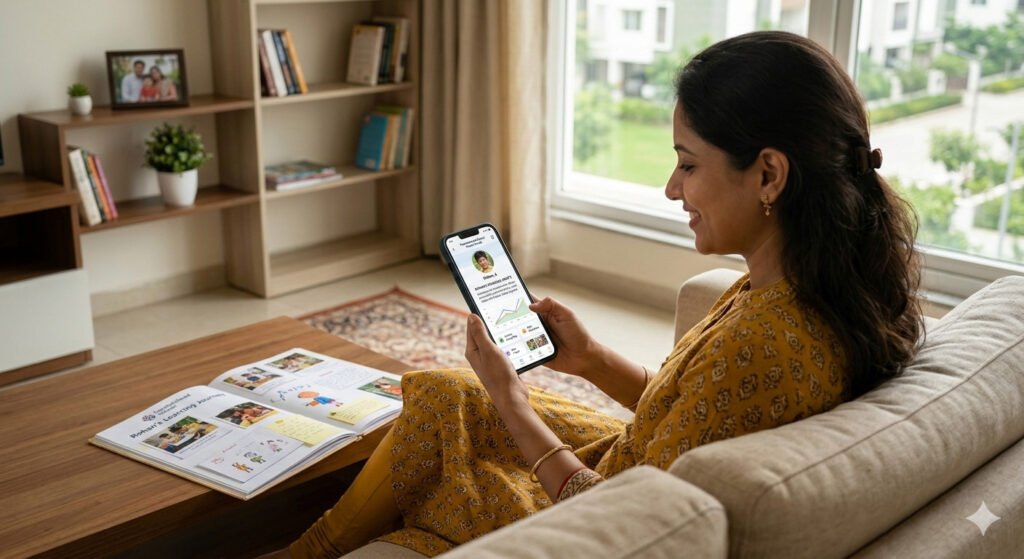
As a working parent, the anxiety of “what is my child doing right now?” is real. Top play schools bridge this gap through absolute transparency.
Look for schools that offer more than just a WhatsApp group with occasional photos. You want structured, meaningful feedback. Does the school use an app for daily updates on meals, naps, and activities? Do they provide regular, data-driven developmental assessments that track specific milestones (e.g., “Rohan has started sorting blocks by color” rather than just “Rohan is a good boy“)? A school should act as your partner in parenting, giving you insights that help you continue the learning process at home.
Conclusion: Trust Your Instincts
Evaluating a play school is a mix of objective checks and subjective feelings. You can verify the curriculum, check the safety protocols, and calculate the commute time, but ultimately, you have to trust your gut. When you walk into the campus, does it feel joyful? Do the children look engaged and happy? Do the teachers look calm?
Taking the time to research and ask the hard questions now will ensure your child’s first step into the world of education is a confident, happy, and safe one.