
The Classrooms of 2026: Why AI, AR, and VR Labs are the New Essentials
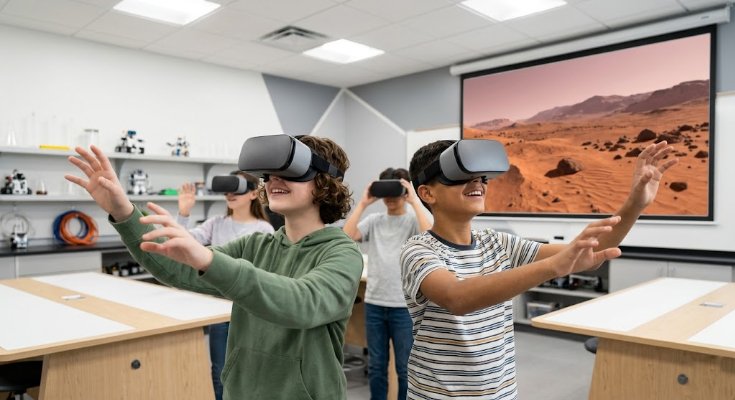
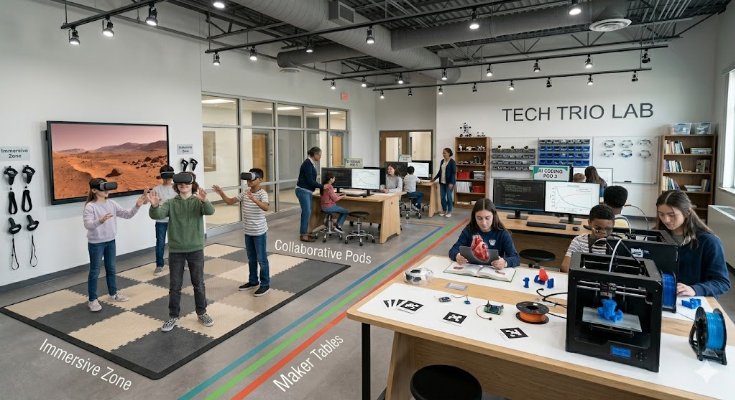
The integration of immersive technology and Artificial Intelligence in modern school infrastructure. Target Audience: Parents and educators looking to understand how high-tech labs transform the learning experience from passive to active.
The days of students sitting in neat rows, staring at a static chalkboard, are rapidly fading into history. As we move through 2026, the definition of a “well-equipped school” has moved far beyond having a few tablets or a basic computer lab. Today, the most progressive educational institutions are investing in dedicated AI, AR, and VR Labs.
But these aren’t just flashy rooms filled with expensive gadgets. When integrated correctly, these labs represent a fundamental shift in how children process information.They move the student from being a passive consumer of facts to an active explorer of worlds. Here is why the “Tech Trio” of AI, AR, and VR is the cornerstone of modern excellence in education.
1. The VR Lab: Taking Field Trips to the Impossible
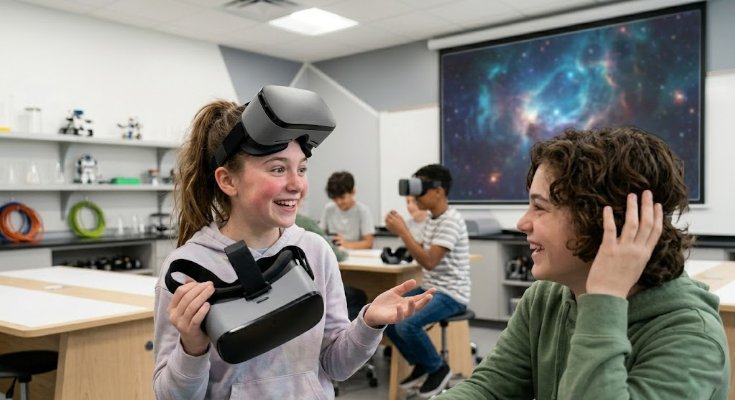
Virtual Reality (VR) is the ultimate tool for empathy and experiential learning. In a VR lab, a history lesson on Ancient Egypt is no longer about memorizing dates; it’s about walking through the Great Pyramid of Giza as it was 4,000 years ago. A biology class doesn’t just look at a diagram of a heart students shrink down to the size of a cell and travel through the bloodstream.
By immersing the senses, VR removes the distractions of the physical classroom. This “deep immersion” has been shown to improve retention rates significantly because the brain processes these experiences as actual memories rather than just something read in a book. It levels the playing field, allowing every child to “travel” the world and explore the stars regardless of their family’s budget.
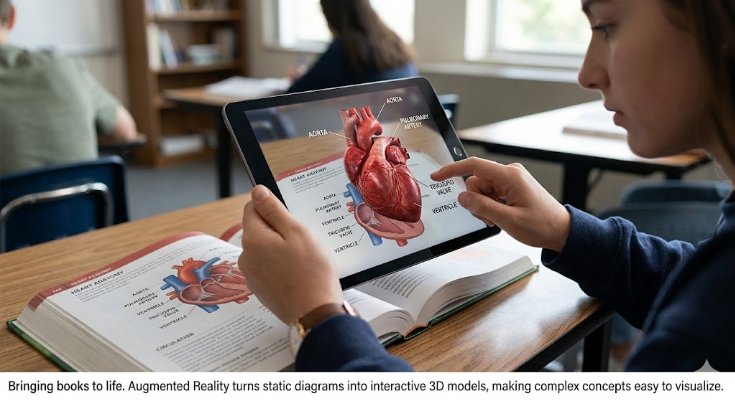
2. The AR Experience: Bringing Textbooks to Life
While VR takes you out of the classroom, Augmented Reality (AR) brings the world into it. Through AR glasses or mobile devices, static pages of a textbook come alive with 3D models. A student studying a chemical reaction can see the molecules bonding in the air right above their desk.
AR is particularly powerful for complex STEM subjects. It allows students to visualize 3D geometry, architectural structures, or mechanical engines in real-time. This interactive layer of information helps bridge the gap between abstract theory and physical reality, making learning feel like a collaborative, hands-on game rather than a chore.
3. The AI Lab: Building the Architects of the Future
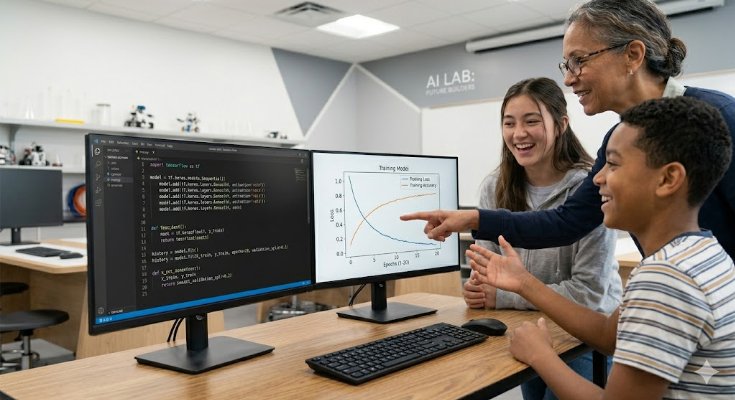
If VR and AR are about how we see the world, the AI Lab is about how we solve its problems. An AI lab is not just a room full of computers; it is a center for computational thinking. Here, students don’t just use appsthey learn how the algorithms behind them work. They experiment with machine learning models, learn the ethics of data, and build “smart” solutions for real-world issues.
In 2026, AI literacy is a basic life skill. A school with a dedicated AI lab ensures its students are not just spectators of the AI revolution, but its creators. They learn to use AI as a co-pilot for creativity, coding, and scientific research, preparing them for a job market where “AI fluency” is the most sought-after line on a resume.
Conclusion: Preparing for a Non-Linear World
The integration of an AI/AR/VR lab signifies that a school is committed to more than just the next board exam; it is committed to the next decade of a child’s life. These labs foster a sense of “fearless exploration.” They teach children that failure in a simulation is just another data point for success. By the time a student graduates from a school equipped with these tools, they don’t just know the worldthey have lived it, built it, and understood the intelligence that drives it.