
Essential Questions to Ask Before Choosing a Play School Near Miyapur Metro
Parents commuting via Miyapur Metro or living in the high-density apartments of Miyapur/Kukatpally. If you live in the Miyapur-Kukatpally corridor, you know that convenience is king. With the Metro station serving as the lifeline for thousands of IT professionals, the area has exploded with preschools, daycares, and “techno” schools. A quick Google search for “best play school near me” will likely throw up dozens of results within a 3km radius of the Miyapur Metro depot.
On the surface, they all look similar: colorful walls, happy cartoon mascots, and promises of “international standards.” But as a parent, how do you peel back the marketing layers? How do you know if the school is truly safe, or just has a security guard who naps at the gate? How do you know if they are building skills, or just babysitting?
To help you cut through the noise, we have compiled the 5 Essential Questions you must ask during your next school visit. These aren’t the standard “What is the fee?” questions. These are the deep-dive questions that reveal the soul and safety of a school.
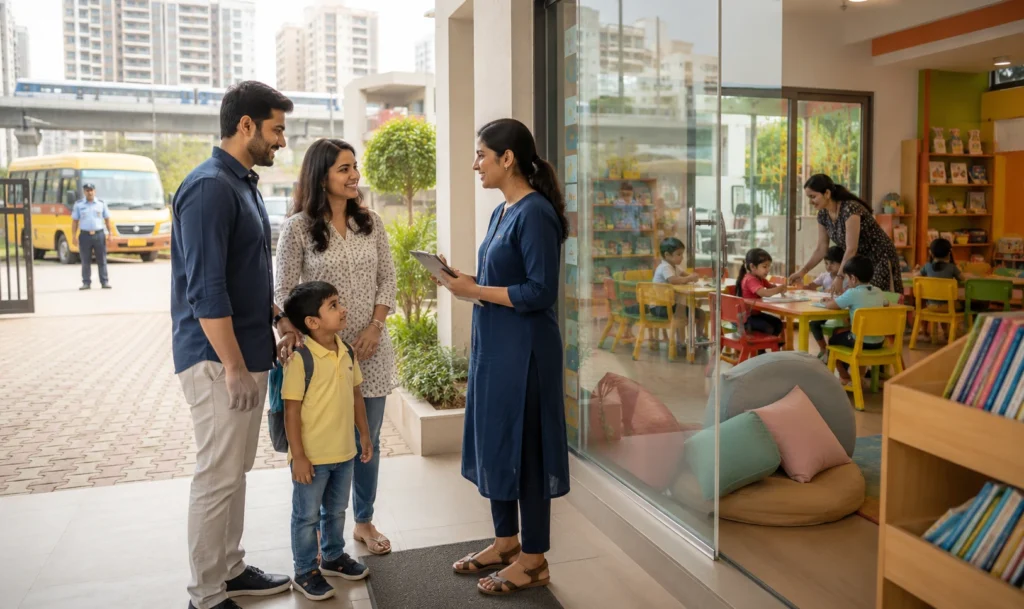
Question 1: "Can I see your 'Handover Protocol' in action?"
Why ask this:
Miyapur is a high-traffic zone. The safety of pickup and drop-off is non-negotiable. Many schools claim to be safe, but their dismissal time is chaotic-kids running out to grab ice cream, drivers honking, and gates left wide open.
The Answer You Want:
You are looking for a system, not just a promise.
The ID Card System: A good school will tell you, “We do not release a child without the official Parent ID Card, even if the grandmother comes.”
The Logbook: If a parent is late or sends a neighbor, there should be a mandatory verification call and a log entry.
Visual Check: Ask to stand near the gate for 10 minutes during dismissal time (usually 12:30 PM or 3:00 PM). Watch the security guards. Are they vigilant? Do they verify identities?
The Red Flag:
If they say, “Oh, don’t worry, our watchman knows all the parents by face,” be careful. Reliance on memory is a security breach waiting to happen.
Question 2: "Do you have a 'Learning Outcomes' book, or just a syllabus?"
Why ask this:
This question separates the “babysitters” from the “educators.” A syllabus just lists topics (e.g., “We teach animals”). A Learning Outcomes system lists skills (e.g., “The child can classify animals into wild and domestic”).
The Answer You Want:
- “Yes, we track specific milestones.”
- Look for a school that can show you a tangible tracker or book.
- Ask: “How will I know if my child is falling behind in social skills?”
- At Fountainhead Global School, we provide a detailed Learning Outcomes Book that tracks granular progress-class-wise, subject-wise, and activity-wise. We don’t just teach; we measure growth.
The Red Flag:
If they hand you a list of rhymes and say, “By the end of the year, they will know 20 poems,” they are focused on rote memorization, not cognitive development.
Question 3: "What is your teacher-retention rate?"
Why ask this:
This is the uncomfortable question that most parents skip. High teacher turnover is a massive problem in private schools in Hyderabad. If a child has three different class teachers in one year, their sense of security is shattered.
The Answer You Want:
- “Our core team has been with us for X years.”
- Consistency is key. You want to hear that teachers stick around because it means the school treats them well. Happy
teachers make happy classrooms.
Ask: “How do you train your new teachers?” A school that invests in training (on topics like child psychology and first aid) is serious about quality.
The Red Flag:
If the principal evades the question or says, “We have many freshers this year,” dig deeper. It might indicate a stressful work environment that will eventually impact your child.
Question 4: "Where is the 'Quiet Corner'?"
Why ask this:
Preschoolers have big emotions. They get overwhelmed, tired, and overstimulated. A classroom shouldn’t just be a place of high-energy singing and dancing; it needs a space for regulation. The Answer You Want:
- You want to see a physical space in the classroom-a cozy corner with cushions, books, or sensory toys-where a child can go if they are crying or angry.
- This shows the school understands Emotional Intelligence (EQ). It shows they view a tantrum as a call for help, not a behavior to be punished.
The Red Flag:
If they say, “If a child cries, we send them to the Principal’s office” or *”We make them sit on the ‘Naughty Chair’,” run. Shaming a child for emotions is an outdated and harmful practice.
Question 5: "How do you handle the 'Miyapur Commute'?"
Why ask this:
If you are using school transport, you need to know about the specifics of the route. The traffic at the JNTU signal or the Miyapur X Roads is unpredictable.
The Answer You Want:
- Live Tracking: “We have an app that lets you see exactly where the bus is.”
- The Attendant: “There is a female attendant (Ayah) on the bus who ensures kids are seated and handed over safely.”
- Route Limit: A good school will try to limit the travel time for preschoolers to 30-40 minutes.
The Red Flag:
If they say, “The driver calls us if there is a delay,” that is not enough. In 2026, real-time GPS tracking is a basic safety standard, not a luxury.
Conclusion: Trust, but Verify
Choosing a school is an act of trust. But when you are trusting strangers with your 3-year-old, “blind trust” isn’t enough. You need
“verified trust.”
Don’t be afraid to ask these tough questions. A quality school will not be offended; they will be impressed. They will appreciate that you care about the details, because they care about them too. At Fountainhead Global School, we invite you to bring this list of questions to our campus. Ask us about our safety protocols. Ask to see our Learning Outcomes Book. Ask us about our teachers. We are ready with the answers, because your child’s safety and growth are our daily mission.