
Why AR, VR and AI Can Add New Dimensions to Classroom Learning
Some classroom concepts are difficult to understand through words, diagrams, or demonstrations alone. Students may read about volcanoes, planetary movement, or human cells yet struggle to picture how these systems work. Emerging technologies offer additional ways to explore such ideas. Augmented reality, virtual reality, and artificial intelligence can make lessons more visual, interactive, and engaging when used with clear educational goals.
AR VR AI in education is not simply about introducing new devices. It is about helping students ask questions, investigate concepts, practise skills, and connect classroom knowledge with the world around them. Technology is most useful when it strengthens teaching rather than replacing teachers, discussion, books, practical work, or human connection.
Understanding the Three Technologies
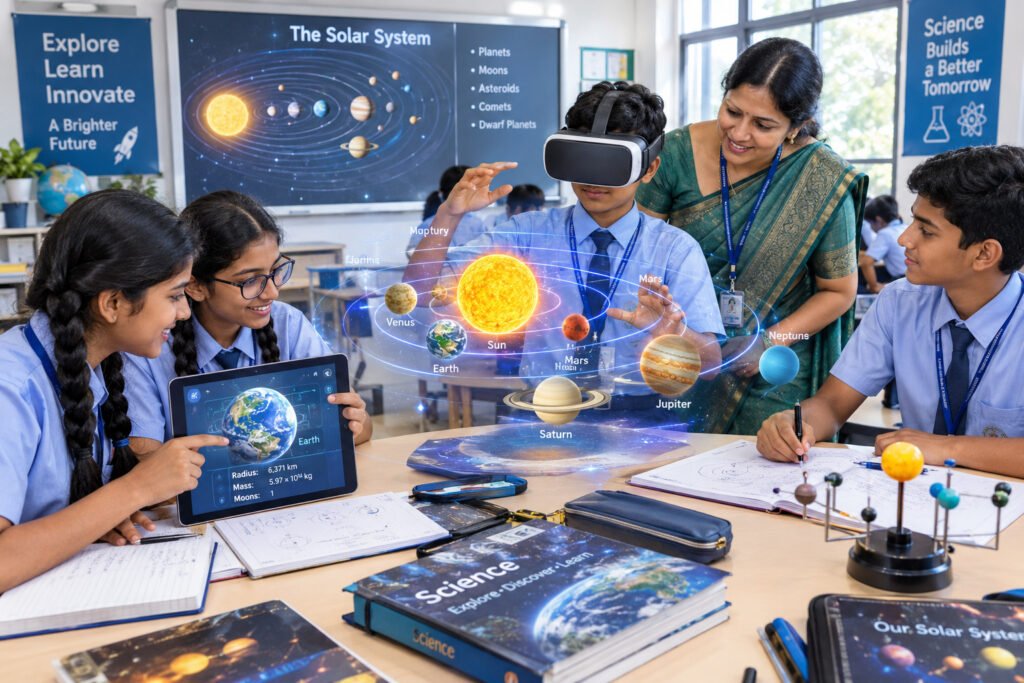
Augmented reality, or AR, adds digital elements to the real world. Students might examine a three-dimensional solar system on a desk or explore labelled plant structures through a compatible device. They can rotate objects and notice details that ordinary pictures may not clearly demonstrate.
Virtual reality, or VR, creates an immersive digital environment. With suitable equipment, learners can explore a historical setting, visit an underwater habitat, or observe a simulated scientific process. Such experiences provide perspectives that may be difficult to recreate in a classroom.
Artificial intelligence, or AI, enables systems to perform tasks such as identifying patterns, generating responses, and adapting activities. Educational AI tools can support practice, provide feedback, and help teachers prepare learning resources.
Each technology serves a different purpose. AR enriches the visible world, VR provides simulated experiences, and AI supports selected forms of learning and feedback.
Making Abstract Concepts Easier to Visualise
Visualising a process is often essential to understanding it. In science, AR models can help learners examine Earth’s layers, parts of a cell, or the phases of the Moon. Students can move around a model, identify components, and discuss how they relate.
In mathematics, interactive three-dimensional shapes help students inspect faces, edges, and vertices. Geometry becomes more tangible when learners rotate shapes rather than relying exclusively on printed diagrams. In geography, virtual environments can introduce landforms, ecosystems, and climate zones.
These experiences support conceptual learning by helping students connect visual representations with underlying ideas. Teachers should connect each activity to a learning objective, ask students to explain their observations, and check whether they can apply the concept independently. The goal is meaningful understanding, not simply an impressive demonstration.
Bringing Learning Experiences Closer
Some educational experiences are difficult to arrange because of distance, cost, time, safety, or access. VR can provide simulated visits to museums, rainforests, space stations, or historical locations. Students can observe details, compare environments, and prepare questions for classroom discussion.
A virtual field experience can be useful before or after a real activity. Before a visit, students can learn what to observe. Afterwards, they can revisit selected details and organise their findings. Simulations can also introduce situations that would be unsafe or impossible to reproduce at school.
Virtual experiences should complement experiments, outdoor learning, reading, and direct observation rather than replace every real-world encounter. This combination supports technology-enhanced learning while keeping meaningful experiences at the centre of education.
Supporting Different Learning Needs
Students do not all understand new ideas at the same speed or through the same explanation. Some benefit from diagrams, spoken instructions, examples, guided practice, or repeated activities. Digital resources can provide additional ways to approach a topic.
AI-supported tools may generate practice questions, offer hints, or explain concepts using simpler language. Teachers can use these resources to support vocabulary development, mathematics practice, and independent revision while giving additional attention to students who need help.
These approaches can contribute to student development by providing opportunities for practice and reflection. However, AI-generated explanations can be incomplete or inaccurate. Student progress should not be judged by a tool alone. Educators must review resources, verify answers, and ensure that learning activities suit students’ ages, abilities, and individual needs.
Encouraging Curiosity and Active Participation
Well-designed technology activities invite students to investigate rather than simply watch. A class exploring a virtual ecosystem might predict what happens when rainfall changes. Students examining an AR model could identify a feature and explain its function. An AI-supported activity might encourage learners to test a question and verify the response using reliable sources.
These tasks develop observation, questioning, reasoning, and discussion. Students can work together, compare findings, and present conclusions. Teachers help transform digital experiences into meaningful learning by asking follow-up questions and connecting evidence with concepts.
Such activities also encourage creative learning, allowing students to explore possibilities, develop explanations, and communicate original ideas. Technology should not be introduced merely because it looks modern. A paper model, classroom experiment, story, or outdoor observation may sometimes teach a concept more effectively. The appropriate method depends on the learning objective and students’ needs.
Building Digital Literacy and Responsible AI Use
Students need guidance to use digital tools thoughtfully. Digital literacy includes evaluating information, protecting personal details, respecting others’ work, and recognising misleading online content.
When students use AI, teachers should explain that generated answers are not automatically correct. Learners must verify important claims, look for supporting evidence, and acknowledge assistance according to school expectations. They should avoid entering private information into tools without appropriate approval.
Schools should select age-appropriate services, review privacy practices, and follow relevant safeguarding requirements. These practices teach students that responsible technology use requires judgement, respect, and accountability.
The Teacher's Role in Technology-Enhanced Classrooms
Teachers connect digital experiences with lasting knowledge. They establish learning objectives, select resources, explain expectations, monitor participation, and encourage reflection.
Before an AR or VR activity, an educator can introduce essential vocabulary and explain what students should observe. During the activity, learners can record questions or complete a guided task. Afterwards, discussion, written reflections, drawings, or practical demonstrations can reveal what they understood.
Professional development is equally important. Teachers need time to explore educational tools, evaluate limitations, and design meaningful lessons. Schools should provide technical support and reliable access so that classroom time remains focused on classroom learning rather than technical difficulties.
Keeping Wellbeing and Balance in Focus
Technology should fit within a balanced school day. Extended screen use can cause discomfort or distraction, while immersive headsets may feel uncomfortable for some students. Activities should be age-appropriate, supervised, accessible, and limited to suitable durations.
Schools should offer alternatives for students who cannot or prefer not to use particular devices. Physical activity, handwriting, printed books, creative arts, group discussions, and face-to-face relationships remain essential parts of education.
The value of technology lies in what it helps students understand or accomplish. More devices do not necessarily produce better learning; thoughtful planning and meaningful interaction matter more.
Developing Problem-Solving Skills for the Future
Technology-based activities can give students opportunities to investigate challenges, test possible solutions, and explain their decisions. For example, learners might use a simulation to explore environmental changes or compare different approaches to a mathematical problem.
These activities encourage problem-solving skills when students are asked to predict outcomes, evaluate evidence, and revise their ideas. Teachers can support this process by encouraging questions instead of immediately providing answers.
Students also need opportunities to apply their understanding without relying entirely on digital assistance. Combining technology with independent tasks helps them develop confidence and judgement.
A balanced educational approach supports future-ready education by encouraging adaptability, curiosity, collaboration, and responsible decision-making. These abilities can help learners respond thoughtfully to new situations as technology and society continue to evolve.
Exploring Technology at Fountainhead Global School
Fountainhead Global School highlights technology-enhanced learning and facilities that include AR, VR, and AI resources. Parents exploring a school environment can ask how these resources connect with subjects, teacher guidance, practical activities, and student development.
Useful questions include how students participate in technology-based lessons, how learning outcomes are assessed, and how digital experiences are balanced with hands-on activities. Understanding the educational purpose behind the tools is more valuable than focusing on equipment alone.
A strong approach combines innovation with clear objectives, supportive teaching, responsible use, and opportunities for independent thinking. Meaningful practical learning ensures that students can connect classroom ideas with observable experiences and everyday situations.
Call to Action
Discover how Fountainhead Global School approaches technology-enhanced learning and student development. Visit the campus, speak with the school team, and learn how classroom technology can support conceptual understanding, creativity, and responsible digital skills.
Conclusion
AR, VR, and AI can add useful dimensions to classroom learning by helping students visualise complex ideas, explore simulated environments, practise skills, and investigate questions in new ways. Their impact depends on thoughtful lesson design, teacher guidance, student wellbeing, and responsible use.
When technology complements discussion, reading, experiments, creativity, and real-world experiences, it can make learning more engaging and accessible. The aim is not to replace established teaching methods but to select suitable approaches for different learning objectives.
For schools and families, the most important question is how technology supports understanding, curiosity, and independent thought. Used carefully, these tools can open new pathways for exploration while keeping meaningful learning and human connection at the centre of education.
Frequently Asked Questions
1. What does AR VR AI in education mean?
It refers to using augmented reality, virtual reality, and artificial intelligence to support classroom instruction, visualise concepts, provide practice opportunities, and encourage interactive learning.
2. How does augmented reality help students learn?
AR overlays digital information and three-dimensional models onto the real environment, helping students explore objects, examine details, and understand complex concepts more visually.
3. What are the benefits of virtual reality in classrooms?
VR offers simulated experiences such as virtual field trips, scientific explorations, and historical environments, helping students investigate places and processes that may be difficult to access physically.
4. Can AI replace teachers in education?
No. AI can assist with practice, feedback, and learning resources, but teachers remain essential for guidance, assessment, emotional support, critical thinking, and responsible technology use.