
How Play-Based Learning Supports Early Childhood Development
For young children, play is a natural way to investigate the world. Building a tower, pretending to run a shop, listening to a story, or exploring leaves in a garden can become meaningful learning experiences. Through these activities, children develop language, coordination, imagination, decision-making, and social awareness.
Play-based learning gives children opportunities to learn through exploration, experimentation, conversation, and discovery. Instead of receiving information passively, they actively participate in experiences that encourage curiosity and understanding. When teachers thoughtfully connect play with developmental goals, everyday activities can support important skills while keeping learning enjoyable.
For parents searching for a preschool in Miyapur, understanding this approach can help them identify an environment that encourages children to explore confidently and develop at their own pace.
Understanding Play-Based Learning
Play-based learning uses engaging activities to support children’s intellectual, physical, social, emotional, and creative development. These activities may include puzzles, building blocks, storytelling, pretend play, music, drawing, sensory exploration, and outdoor discovery.
Children need opportunities for both independent exploration and guided activities. During independent play, they choose what interests them and experiment with available materials. During guided play, teachers introduce questions, demonstrate possibilities, and provide support without controlling every decision.
For example, building a bridge with blocks can encourage children to explore balance, shapes, stability, and problem-solving. A pretend grocery shop introduces counting, communication, categorisation, and cooperation.
These experiences show how play can provide a meaningful context for developing essential skills.
1. Developing Language and Communication
Language develops through listening, speaking, observing, and interacting with others. Play creates natural opportunities for children to practise these abilities.
During pretend activities, children describe objects, ask questions, explain ideas, and learn vocabulary. Storytelling introduces new words, characters, and sequences of events. Songs and rhymes help children recognise sounds and develop listening skills.
Teachers can support language development by introducing useful vocabulary, asking open-ended questions, and encouraging children to express their thoughts. They can also give children sufficient time to respond without rushing them.
Shared reading, picture discussions, puppet shows, and conversation circles make communication enjoyable. These experiences help children express their needs, understand instructions, and gradually become more confident when interacting with teachers and classmates.
2. Building Thinking and Problem-Solving Skills
Children encounter small challenges throughout play. A tower may fall, a puzzle piece may not fit, or a construction project may require a different design. Each situation gives them an opportunity to observe, think, experiment, and try another approach.
Activities involving blocks, sorting objects, matching games, and simple experiments introduce early mathematical and logical concepts. Children begin noticing patterns, comparing quantities, recognising shapes, and understanding cause and effect.
Teachers can encourage independent thinking by asking questions such as, “What could you try next?” or “How might we make this stronger?” These prompts help children consider possibilities instead of immediately depending on adults for solutions.
Such experiences support curiosity, persistence, and flexible thinking, which remain valuable throughout a child’s educational journey.
3. Strengthening Physical Coordination
Physical activity plays an important role in childhood development. Running, jumping, balancing, dancing, and throwing encourage children to develop gross motor skills, body awareness, and spatial coordination.
Fine motor skills develop through activities such as threading beads, handling crayons, moulding clay, turning book pages, and stacking smaller objects. These movements gradually strengthen the hand control needed for drawing, dressing, and early writing.
A balanced learning environment provides opportunities for movement alongside quieter activities. Teachers should ensure that materials and play spaces are appropriate for children’s ages and abilities.
Regular physical exploration also allows children to practise following instructions, taking turns, and becoming more aware of their surroundings.
4. Encouraging Creativity and Imagination
Pretend play allows children to create stories, explore roles, and make sense of familiar experiences. A cardboard box might become a bus, a collection of toys might inspire a story, or a pretend restaurant might encourage children to organise their own activity.
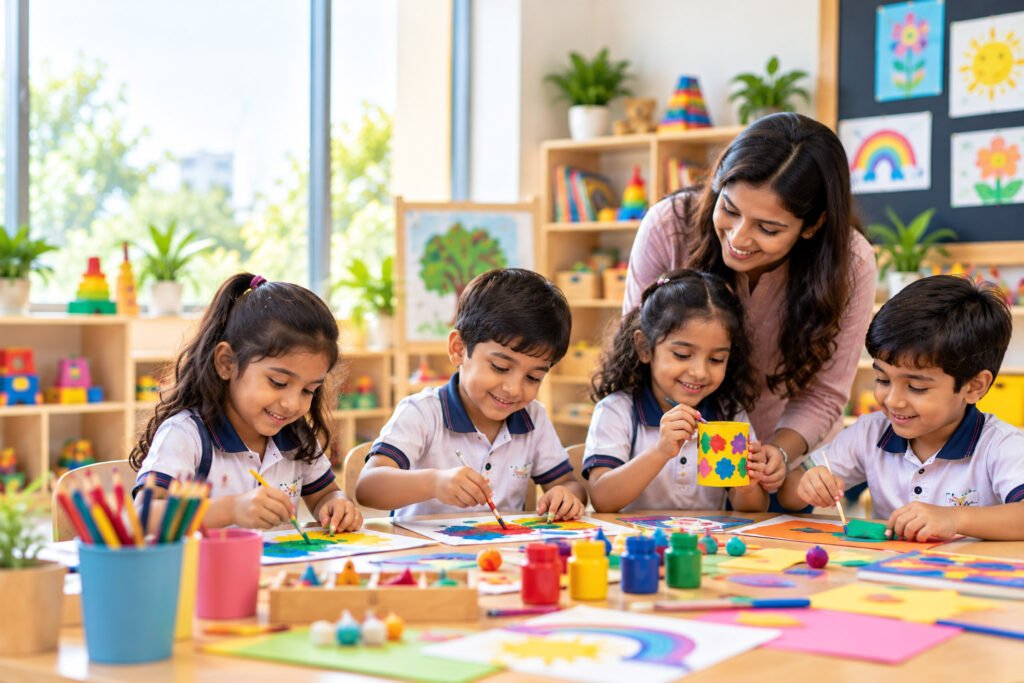
Art and craft activities provide further opportunities for creative learning. Drawing, painting, clay modelling, music, and building with recycled materials allow children to experiment with colours, textures, sounds, and different ideas.
Adults can support creativity by offering varied materials and welcoming individual approaches. Instead of expecting every child to produce an identical result, teachers can invite children to explain their creations and describe their decisions.
This freedom helps children understand that learning involves imagination, experimentation, and the confidence to express original ideas.
5. Developing Social and Emotional Skills
Playing with classmates provides opportunities to practise sharing, cooperation, patience, and negotiation. Children learn to take turns, agree on roles, listen to others, and work towards a common goal.
Sometimes disagreements occur when children want the same toy or have different ideas. With patient guidance, teachers can help them recognise feelings, communicate respectfully, and consider possible solutions.
Play also gives children opportunities to experience excitement, frustration, uncertainty, and achievement. Supportive adults can help them identify emotions and develop appropriate ways to express them.
Children do not all participate socially in the same way. Some join group activities immediately, while others prefer to observe before participating. Predictable routines, reassurance, and respectful encouragement help each child develop confidence.
6. Connecting Play With Early Academic Concepts
Play can introduce foundational concepts in literacy, mathematics, science, and environmental awareness.
Sorting leaves by shape encourages observation and classification. Counting objects during a pretend shopping activity introduces number concepts. Listening for sounds in nursery rhymes supports early phonological awareness, while planting seeds encourages questions about growth and living things.
These activities connect abstract ideas with experiences children can see, touch, discuss, and explore.
Effective early years education focuses on age-appropriate learning rather than rushing children through formal academic tasks. Teachers can build strong foundations by connecting everyday discoveries with language, numeracy, reasoning, and practical experiences.
When children understand concepts through meaningful activities, they gain opportunities to practise and apply their knowledge in different situations.
7. The Teacher's Role in Purposeful Play
Successful play-based learning requires thoughtful planning and observation. Teachers prepare safe materials, organise accessible spaces, identify developmental goals, and observe how children participate.
They may introduce a new word, demonstrate how to use a resource, or ask a question that extends an activity. They also recognise when children need encouragement and when independent exploration should continue without interruption.
Observation helps educators understand children’s interests, emerging abilities, and areas where additional support may be useful. Progress can be noticed through communication, participation, problem-solving, coordination, and growing independence.
Communication with families strengthens this process. Sharing observations and suggesting simple activities for home helps connect classroom experiences with children’s everyday lives.
8. What Parents Should Look For in a Preschool
When visiting a preschool in Miyapur, parents can ask how play is incorporated into the daily routine and what children learn through different activities.
Consider these practical indicators:
- A balance of storytelling, movement, creative activities, and independent exploration.
- Teachers who encourage questions and listen carefully to children’s ideas.
- Age-appropriate materials for building, sorting, imagining, and investigating.
- Safe spaces that support physical activity and quiet concentration.
- Opportunities for children to communicate and cooperate with classmates.
- Regular updates about children’s participation and developmental progress.
Facilities can support learning, but their value depends on how they are used. Parents should ask educators to explain the purpose of activities and how children receive individual attention.
A suitable environment should encourage exploration while providing appropriate structure, supervision, and emotional support.
9. Bringing Play-Based Learning Into Everyday Life
Families can encourage development without purchasing expensive toys. Everyday routines offer many opportunities to explore language, mathematics, coordination, and creativity.
Invite children to count fruit, sort laundry by colour, help organise safe household objects, or describe what they notice during a walk. Read picture books together, invent stories, sing songs, and play simple turn-taking games.
Allow children time to lead activities and repeat experiences they enjoy. Listen to their questions and offer encouragement without completing every task for them.
Parents should choose activities appropriate to their child’s age and supervise potentially hazardous materials. Small objects, water, and tools require particular care.
Consistent interaction helps children feel supported while developing curiosity, independence, and confidence.
Call to Action
Explore the pre-primary programme at Fountainhead Global School to learn about its learning activities, facilities, and approach to childhood development. Visit the campus and speak with the admissions team to understand how play, creativity, communication, and exploration are incorporated into children’s daily learning experiences.
Conclusion
Play-based learning supports early childhood development by combining language, thinking, movement, imagination, and social interaction in meaningful experiences. It allows children to investigate ideas, practise new skills, manage emotions, and learn through discovery.
For families choosing a preschool in Miyapur, understanding the role of purposeful play can help them recognise an environment that values both development and enjoyment. A supportive preschool provides safe exploration, thoughtful teaching, creative opportunities, and respect for individual progress.
When play is guided with care, children develop a positive relationship with learning. Their curiosity becomes an opportunity to discover, ask questions, build relationships, and approach new experiences with growing confidence.
Frequently Asked Questions
1. What is play-based learning in preschool?
Play-based learning uses activities such as building, storytelling, art, puzzles, and pretend play to help children develop language, reasoning, coordination, creativity, and social skills.
2. How does play-based learning support early childhood development?
It provides opportunities for children to practise communication, solve problems, express emotions, develop physical coordination, and understand concepts through hands-on experiences.
3. Is play-based learning useful for early academic skills?
Yes. Purposeful play can introduce foundational literacy, numeracy, science, and reasoning concepts through age-appropriate activities that encourage understanding and participation.
4. How can parents identify a good preschool in Miyapur?
Look for qualified and supportive teachers, safe learning spaces, purposeful play activities, creative opportunities, age-appropriate materials, and clear communication about children’s progress.