
A Parent's Guide to Choosing a Preschool in Miyapur
Choosing a preschool is one of the first important educational decisions parents make for their child. The early years shape how children communicate, explore their surroundings, develop relationships, and approach new experiences. A preschool should therefore offer more than a classroom and a daily routine. It should provide a welcoming environment where children feel safe, curious, supported, and excited to learn.
For families exploring the Best preschool in Miyapur, the number of available options can make the decision challenging. Parents may need to consider teaching methods, teacher qualifications, hygiene, safety, classroom facilities, location, and the school’s approach to individual development.
The best way to make a confident decision is to look beyond brochures and attractive campus photographs. Understand how the school works, observe how teachers interact with children, and identify whether its learning environment matches your child’s needs.
This guide explains the essential factors parents should consider when choosing a preschool in Miyapur, Hyderabad.
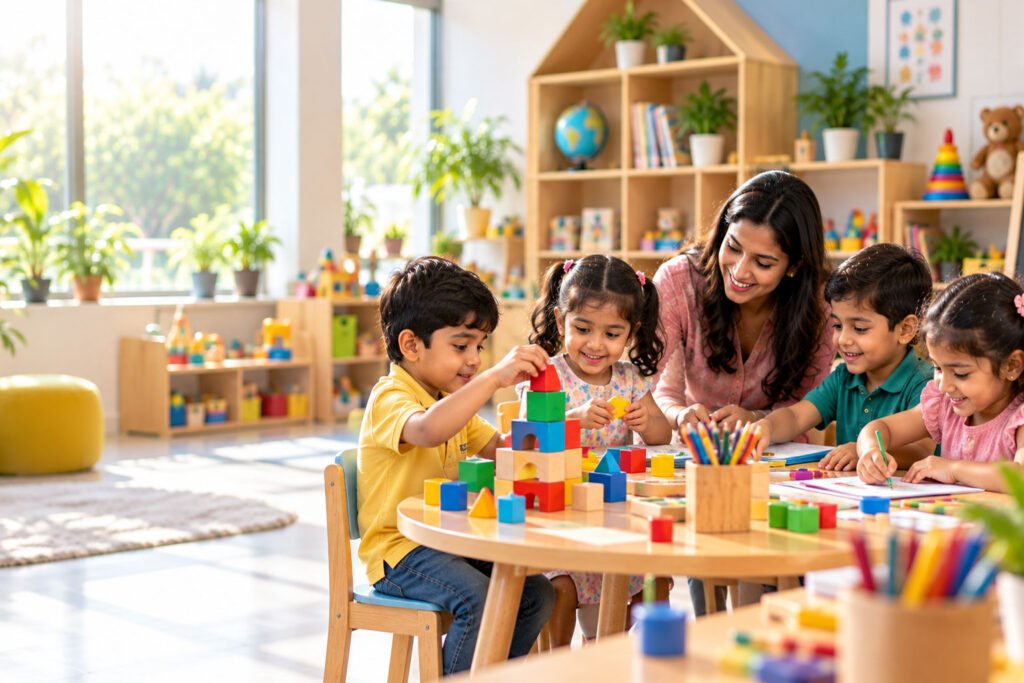
1. Understand Your Child's Learning Needs
Every child develops at a different pace. Some children enjoy group activities immediately, while others need more time to become comfortable in unfamiliar surroundings. Some learn by listening to stories, while others prefer touching objects, building structures, drawing, or exploring outdoors.
Before shortlisting schools, consider your child’s personality, interests, communication skills, and level of independence.
A suitable preschool curriculum should accommodate different learning styles while helping children develop essential early skills. Look for a balanced approach that introduces language, numbers, creativity, movement, and social interaction through age-appropriate activities.
Ask the school how teachers support children who need additional encouragement. The answer can reveal whether the institution values individual progress instead of expecting every child to learn in exactly the same way.
2. Look for Play-Based and Experiential Learning
Preschool children learn effectively when they can actively participate in experiences rather than simply memorise information. Play can help them understand basic concepts, experiment with ideas, express themselves, and develop confidence.
For example, sorting colourful objects can introduce classification and counting. Building with blocks can encourage spatial awareness and problem-solving. Gardening activities can help children observe nature, practise responsibility, and learn about living things.
When evaluating a school, ask how activities connect with learning objectives. A well-designed experiential learning approach combines enjoyment with meaningful opportunities to discover, question, practise, and reflect.
Fountainhead Global School highlights inquiry-based learning in its pre-primary environment, using practical experiences to encourage children to investigate concepts and develop understanding.
3. Evaluate Teacher Quality and Classroom Interaction
Teachers have a significant influence on a child’s first experience of formal education. Their patience, communication, and ability to recognise children’s needs can shape how comfortable children feel at school.
During a campus visit, observe whether teachers speak respectfully, listen to children, and encourage questions. Notice how they respond when a child struggles with an activity or becomes upset.
A supportive teacher helps children participate without creating unnecessary pressure. Positive encouragement, storytelling, guided exploration, and constructive feedback can make unfamiliar experiences easier to manage.
Ask about teacher qualifications, early childhood training, classroom support staff, and the way individual progress is monitored. Also enquire about the teacher-child ratio and how the school ensures that children receive adequate attention.
A nurturing environment supports early childhood development by helping children build language, motor coordination, confidence, and social understanding through everyday classroom experiences.
4. Make Safety and Hygiene Non-Negotiable
A preschool must provide an environment designed around the needs of young children. Safety is not limited to the main entrance; it includes classrooms, washrooms, play areas, furniture, activity materials, and the procedures followed throughout the day.
During your visit, check:
- Whether entry and visitor access are controlled.
- Whether CCTV monitoring and child handover procedures are in place.
- Whether classrooms, toys, and frequently touched surfaces are cleaned regularly.
- Whether furniture and play equipment are appropriate for children’s ages.
- Whether washrooms are clean, accessible, and designed for young children.
- Whether staff members understand childcare, hygiene, and emergency procedures.
Ask how the school responds to accidents, illness, separation anxiety, or other unexpected situations. Clear answers are more useful than general assurances.
Fountainhead Global School describes its pre-primary facilities as including child-sized washrooms, sanitised play areas, trained female support staff, CCTV monitoring, and verified entry procedures. Parents should still visit the campus and ask how these measures are implemented in everyday practice.
A thoughtfully designed child-friendly school environment helps children explore their surroundings while giving parents greater confidence in their daily care.
5. Check the Facilities That Support Holistic Development
Facilities matter when they serve a clear educational purpose. A school does not need the most elaborate infrastructure to provide meaningful learning, but it should offer safe, engaging spaces for different kinds of activities.
When touring a preschool, look for opportunities for:
- Creative expression: Drawing, painting, music, storytelling, and craft activities.
- Physical development: Indoor and outdoor play areas that encourage movement and coordination.
- Language development: Storybooks, conversations, rhymes, and language activities.
- Sensory exploration: Age-appropriate materials that children can sort, touch, observe, and investigate.
- Practical learning: Gardening, simple building activities, and supervised everyday tasks.
- Social interaction: Shared play, group projects, and opportunities to practise cooperation.
Fountainhead Global School lists facilities and learning spaces such as a sandpit room, indoor and interactive play areas, arts and crafts, a vegetable garden, a Brain Gym, a language lab, and a STEAM Maker Space. These spaces can offer valuable learning opportunities when they are integrated into age-appropriate activities.
The key question is not how many facilities a school advertises, but how children use them and what skills they develop through those experiences.
7. Examine How Progress Is Assessed
Preschool assessment should help teachers understand each child’s development rather than place unnecessary pressure on young learners.
At this stage, meaningful progress can include learning to communicate a need, recognising colours and shapes, following instructions, holding a pencil, participating in a group, or completing a simple task independently.
Ask how teachers observe progress and share feedback with families. Useful methods may include activity observations, developmental records, samples of children’s work, and discussions about emerging strengths or areas needing support.
Fountainhead Global School describes a 360-degree assessment approach as part of its broader educational model. During your enquiry, ask how progress monitoring is adapted for preschool children and how parents receive information about individual development.
Assessment should help educators plan suitable next steps and provide additional encouragement where needed. It should never become a reason to compare children or rush them through developmental milestones.
8. Consider Location, Timings, and Daily Routines
A preschool’s location can significantly affect your family’s daily routine. Miyapur and neighbouring residential areas include families with different commuting patterns, working hours, and childcare arrangements.
Consider the travel time from home, traffic conditions during drop-off and collection, school timings, transport arrangements, and the availability of after-school care if required.
Also ask about the daily schedule. Young children need a sensible balance of guided activities, free play, meals, rest, outdoor movement, and transitions between tasks.
A predictable routine helps children understand what comes next and gradually develop independence. At the same time, the schedule should allow flexibility when a child needs reassurance or additional time to complete an activity.
Convenience alone should not determine your choice, but a manageable routine can help your child attend school comfortably and consistently.
9. Look for Strong Parent-School Communication
A child’s learning journey becomes more consistent when parents and teachers work together. Families should know how the child is settling in, which activities they enjoy, and where additional support might be helpful.
Before admission, ask how the school shares updates, whether parent-teacher meetings are scheduled, and whom you should contact with questions or concerns. Find out whether teachers provide practical suggestions for continuing learning at home.
Children benefit when the expectations they experience at school are reinforced through simple routines at home, such as putting toys away, listening to stories, helping with small tasks, and expressing their feelings.
Schools that support emotional intelligence for children help young learners recognise emotions, practise empathy, communicate needs, and develop positive relationships. These skills are built gradually through everyday interactions, not through occasional lessons alone.
10. Check Readiness for the Next Stage
Preschool should establish a positive foundation for the transition to kindergarten and primary school. This does not mean expecting young children to complete advanced worksheets or read beyond their developmental stage.
Instead, look for opportunities to develop school readiness skills, including listening, speaking, recognising basic patterns, following simple instructions, managing belongings, and participating in group activities.
Children also need confidence to ask for help, try unfamiliar tasks, and recover when something does not work the first time. These abilities make classroom participation more comfortable as learning becomes progressively structured.
Ask how the school supports the transition from nursery to the next pre-primary level. A clear developmental pathway helps parents understand what their child is learning and which skills will be encouraged over time.
11. Prepare the Right Questions Before Admission
A campus visit is more productive when parents arrive with specific questions. Use this checklist during your preschool search in Miyapur.
- What teaching methods are used for each age group?
- How are language, numeracy, creativity, and physical development encouraged?
- How do teachers support children who take longer to adjust?
- What are the school’s safety, hygiene, and emergency procedures?
- How are teachers trained to work with young children?
- How is developmental progress observed and communicated?
- Which facilities are used for regular learning activities?
- What are the school timings, transport arrangements, and fee structure?
- How can parents communicate with teachers?
- What are the admission requirements and age criteria for the relevant academic year?
Pay attention to how clearly the school answers your questions. Transparent explanations can help you understand the school’s priorities and decide whether they align with your family’s expectations.
Why Consider Fountainhead Global School in Miyapur?
Fountainhead Global School presents an educational approach that combines conceptual understanding, experiential learning, life skills, creative activities, and attention to children’s broader development. Its listed learning spaces include a vegetable garden, sandpit room, arts and crafts areas, a language lab, and interactive play facilities.
Parents exploring the school can arrange a campus visit, speak with the admissions team, and learn how its pre-primary programme supports children’s everyday learning and development.
For families researching preschool admission in Miyapur, direct observation is particularly valuable. Seeing a classroom in action and understanding the daily routine can help you assess whether the environment feels appropriate for your child.
Visit the official website at Fountainhead Global School to explore its programmes and admission information. You can also contact the school to confirm current admission requirements, availability, timings, and fees.
Conclusion
Choosing a preschool is about finding the right environment for your child’s first steps into formal learning. Teaching quality, safety, emotional support, practical activities, facilities, communication, and daily routines all deserve careful consideration.
The Best preschool in Miyapur for your family should be a place where your child feels secure enough to explore, supported enough to ask questions, and encouraged enough to develop at their own pace.
Take time to visit shortlisted schools, observe classroom interactions, ask practical questions, and understand how each institution approaches early childhood education. A thoughtful decision today can help your child build a positive relationship with learning that continues into the years ahead.
Ready to explore preschool options? Visit Fountainhead Global School to learn more about its pre-primary programme and arrange an enquiry about admissions.